Paving advice
Resurfacing or Rebuilding
How to Know What Your Driveway Needs
The foundation test, the symptoms that rule out resurfacing, typical cases in Laval, Montreal and the North Shore, and a checklist before you sign.
- Free quoteWe come take a look, no obligation.
- Clear priceEvery step spelled out in the quote.
- Hot asphaltLaid with a paver, rolled.
- Quick callbackThe owner, not a salesperson.
On this page
Two driveways can look identical from the street (same grey, same cracks) and need two completely different jobs. One can be resurfaced in a day; the other has to be excavated and given a new foundation. The price, the timeline and the result have nothing in common. Here is how we decide, and how you can already form an opinion before our visit.
What each option really does
Resurfacing means laying a new layer of hot asphalt over the existing one, after cleaning, repairing defects and applying a tack coat. The foundation is left untouched: the surface is renewed. It raises the level slightly, which calls for careful transitions at the garage, the sidewalk and the curbs.
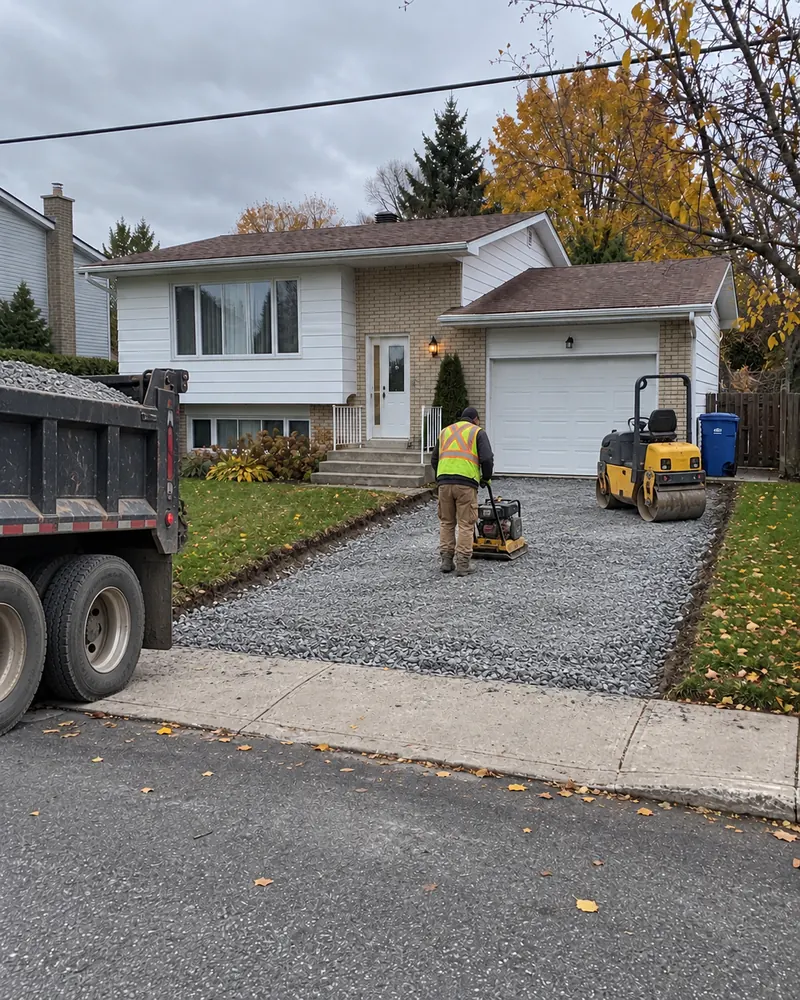
Rebuilding means removing the old asphalt, correcting or completely redoing the crushed stone foundation, compacting it in layers, restoring the drainage slopes, then paving. You start from scratch: it takes longer and costs more, but it is the only option when the problem is below the surface.
So the whole question is: is your foundation still good?
The foundation test: what we look at during the visit
During an assessment, we do not look at the asphalt first. We look at what it tells us about what is underneath.
- Flatness. We look at the driveway from a low angle and after a rain. Dips, waves or puddles mean the base has settled or been washed out in places.
- The type of cracks. Long, isolated cracks come from the surface (shrinkage, age, joints). A network of closely spaced “alligator skin” cracks comes from a base that moves under load.
- The edges. An edge that is crumbling over a significant width means the asphalt has no lateral support, or that the foundation does not extend far enough past it.
- Existing thickness. We core or probe at the edge of the driveway to find out the asphalt thickness and the nature of the foundation. Many original driveways, laid quickly by a builder, sit on very little stone.
- Drainage. Where does the water go? Toward the street, a catch basin, or against the garage? Resurfacing follows the existing slope; if the slope has to be corrected, it usually means a rebuild.
- What borders the driveway. Mature tree roots, a ditch, paving stones, concrete: every transition affects whether resurfacing is feasible.
You can do part of this inspection yourself, after a rain, with a flashlight held close to the ground to reveal the dips.
The symptoms that rule out resurfacing
Resurfacing is only proposed if the base is sound. When one of these signs is present, a new layer will not hold. It will reproduce the same defects, sometimes as early as the first spring:
- Network cracking (alligator skin) over a large area. The base has given way; the new layer will crack in the same place.
- Multiple or deep sunken areas. The foundation has settled unevenly; covering a dip means covering an active problem.
- Frost heaves that come back every winter. Water is reaching a poorly drained foundation; it needs to be redone, not hidden.
- Very thin original asphalt on little stone. Resurfacing adds weight to a base that already cannot carry enough.
- Reverse slope or water running toward the building. Impossible to correct without redoing the foundation levels.
- Old asphalt that is disintegrating at the surface. A tack coat cannot bond to a layer that is crumbling.
On the other hand, a grey, worn surface, isolated cracks, a few earlier small repairs and acceptable flatness: that is the ideal case for resurfacing.
How long each option lasts
We are often asked for a number of years. We prefer not to make one up: a driveway’s lifespan depends on the foundation, the compacted thickness, the drainage, the traffic and the maintenance, and nobody can guarantee you a figure without knowing those five things. What we can honestly say:
- A well-done resurfacing on a sound base ages like a new driveway, because the base was already stabilized.
- A resurfacing on a base that moves ages like the base: badly, and fast.
- A well-compacted, well-drained rebuild is the most solid starting point there is; sealer then does the rest.
That is why our quote always states what is proposed and why, with the warranty.
Typical cases in our region
New house on the North Shore. Original driveway laid by the builder on a minimal base, which cracks and sinks early. Frequent diagnosis: rebuild, because the problem is the foundation, not the surface. It is the most common case we see in Terrebonne and Mascouche.
Laval bungalow. Older driveway, often widened over the years, on clay soils that move with moisture. If the base was done right back then and the surface is simply worn: resurfacing. If the clay has done its work and the driveway is wavy: rebuild with a more generous foundation and better drainage.
Montreal plex. Narrow driveway, sloping toward the garage or tied into the City sidewalk, with difficult access for machinery. Resurfacing is attractive because it is fast, but the sidewalk transitions and drainage toward the building are often the real issues; we look first at where the water goes.
Checklist before you sign
Whichever option is chosen, your quote should specify:
- the area measured on site;
- the option chosen (resurfacing or rebuild) and the reason;
- for a rebuild: the excavation depth, the type of stone, compaction in layers;
- for resurfacing: the planned preparation (repairs, tack coat) and how the transitions will be handled;
- the compacted asphalt thickness;
- slope and drainage management;
- site cleanup and debris disposal;
- the warranty and its terms.
A quote that does not say which of the two options was chosen does not let you compare. Our guide How to choose a paving contractor goes further on the questions to ask.
Still unsure? That is normal: it is exactly the kind of decision that should not be made from a distance. Request a free visit and we will tell you, on site, what your driveway needs, and what it does not.
resurfacingfoundationdrivewayquote
Written by the Asphalte Pro Québec team, asphalt paving contractor in Montreal, Laval and Terrebonne.
Go further.
How much does an asphalt driveway cost in 2026?
Rebuilt driveway $6–10/ft², resurfacing $3–5.50, sealcoating $0.30–0.45, cracks about $3 per linear foot. Dated, sourced 2026 prices, a calculator and real examples.
Read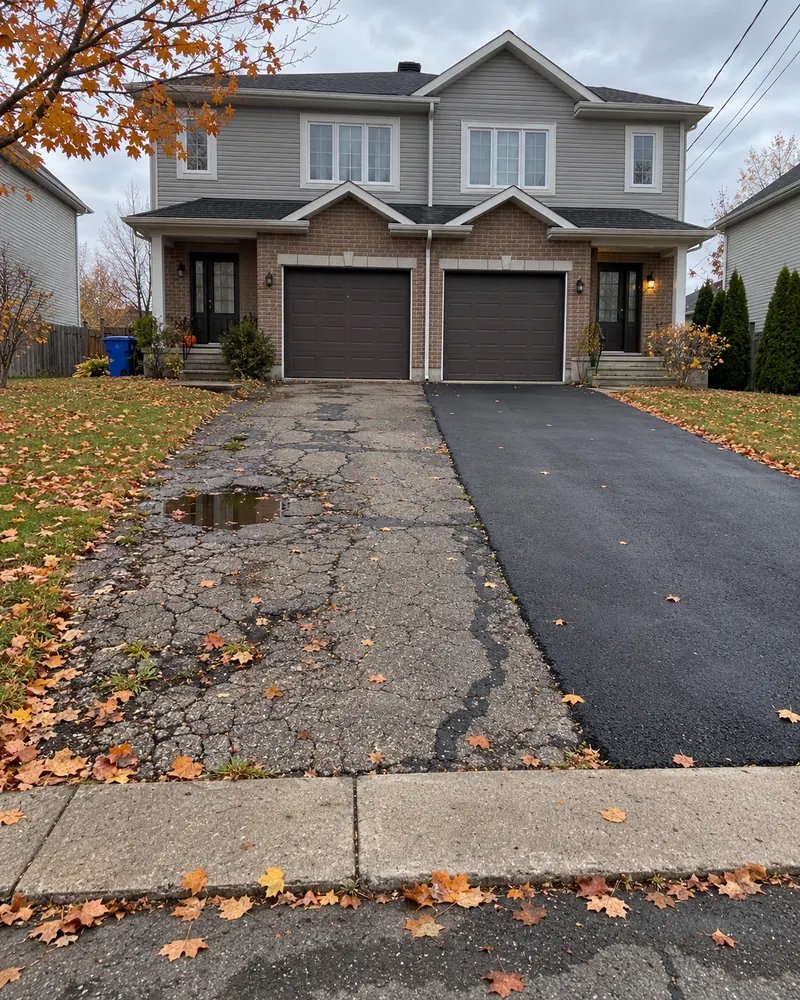
How Long Does an Asphalt Driveway Last in Quebec (and How to Extend Its Life)
Foundation, thickness, drainage, sealer: what determines the lifespan of an asphalt driveway in Quebec, the end-of-life signs, the mistakes to avoid.
Read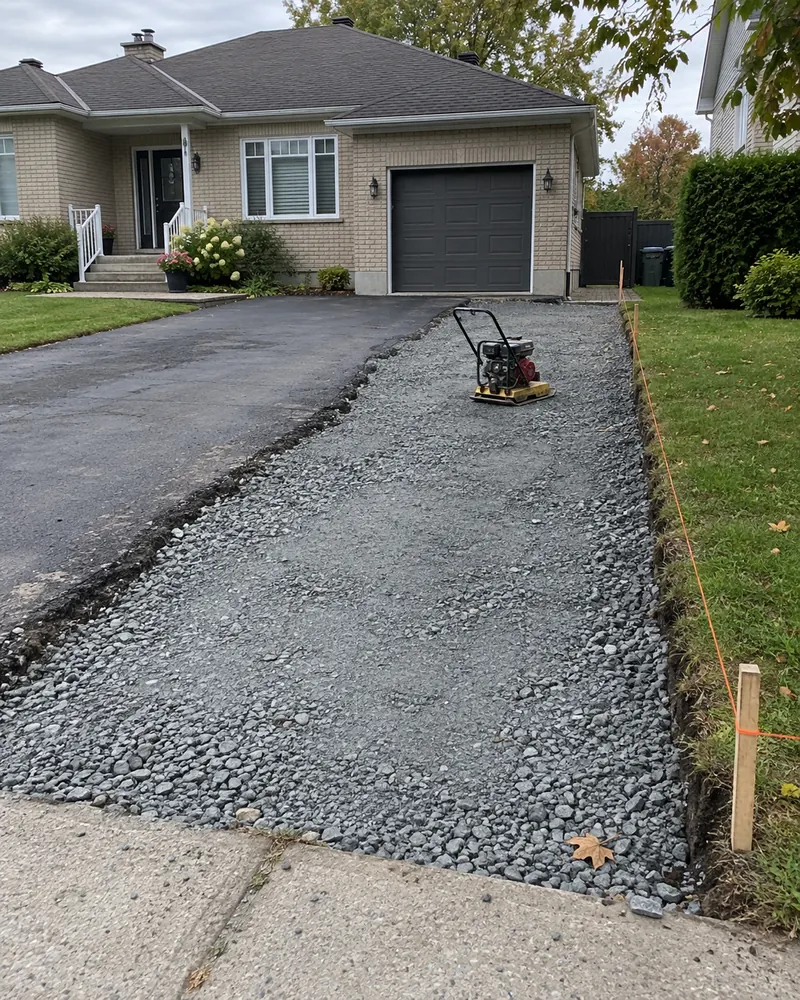
Driveway permits: what 16 cities require (rules checked in 2026)
Repaving as is, gravel to asphalt, widening: what Laval, Terrebonne, Longueuil, Brossard and 12 other cities require. Widths, curb cuts, fees and deadlines.
ReadBefore the freeze, not next spring.
Two minutes of questions, or a photo by text. We call you back quickly, come take a look and you get your price, free.