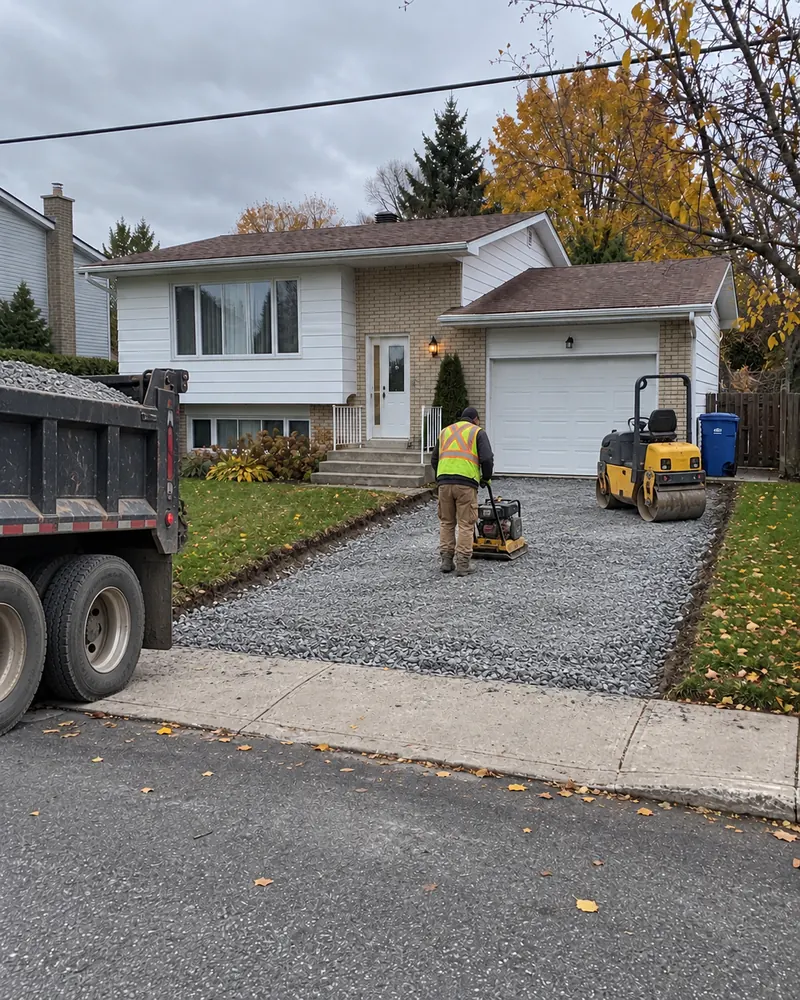
Service · Excavation and foundation
Excavation and stone foundation in Montréal and Laval
The part of your driveway you’ll never see, and the one that decides everything
Excavation, removal of the old surface, crushed stone compacted in layers and drainage slopes. The base that makes asphalt hold, or a site ready to pave for your project.
- Free quoteWe come take a look, no obligation.
- Clear priceEvery step spelled out in the quote.
- Hot asphaltLaid with a paver, rolled.
- Quick callbackThe owner, not a salesperson.
On this page
On installation day, nobody sees the foundation. That’s exactly why it’s where the corners get cut, and where driveways die. A base that’s too thin, not compacted in layers or laid without a slope holds water, freezes, and moves everything above it. You can lay the best asphalt in the world on a bad base: it will crack.
Paving is only as good as its foundation. We handle the excavation, removal of the old materials, placement of crushed stone (MG-20 / 0-¾) compacted in layers, and grading with drainage slopes: before paving, or to prepare a site for another contractor.
Our equipment lets us work on small residential driveways as well as large parking lots, with debris removal included.
Ideal for
- New lot or gravel driveway
- Clay soil or recurring settling
- Parking lot expansion
- Full reconstruction after damage
What changes the price
Excavation and the base are part of a fully rebuilt driveway, about $6 to $10 per square foot in 2026; depth is the item that moves that price most. Here is what moves your quote. See 2026 prices and the calculator.
- The excavation depth, determined by the soil in place and the expected load.
- The materials to remove and haul away: gravel, old asphalt, concrete, roots, soil.
- The type of soil: clay or wet soil needs a thicker foundation, sometimes a drain.
- The thickness of crushed stone and the number of compacted layers.
- Access for the excavator and the trucks, and the hauling distance for the debris.
Everything that affects the price of paving
The mistakes we often see
- A foundation that’s too thin to save on stone: it’s the most expensive saving there is.
- Dumping all the stone at once and compacting a single time: the deeper layers stay loose.
- Grading flat, with no slope: water stays under the asphalt instead of draining away.
- Digging without locating the utility lines: a broken gas or water main costs far more than the call to Info-Excavation.
The concrete benefits
- Ground that stops moving. Crushed stone placed and compacted layer by layer: the voids are eliminated, and the spring settling never happens.
- Water goes away from your house. Calculated slopes and drains where needed: no puddles in front of the garage, no seepage toward your home’s foundation.
- No grey zone between contractors. Excavation, foundation and paving by the same crew, debris disposed of by the rules. One responsibility, one number to call if something’s off.
- Debris removal. Old asphalt, concrete and soil disposed of by the rules.
How we proceed, step by step
- Locating and marking underground utilities
- Excavation to the required depth and removal of materials
- Crushed stone placed in layers, mechanical compaction
- Final grading with drainage slopes
- Paving (or handover of a site ready to pave)
About this service
How thick does the foundation need to be?
Generally 6 to 8 inches of compacted stone for a residential driveway, 10 to 12 inches and more for a commercial parking lot, depending on the soil and the load.
How long does the excavation take?
A standard residential driveway is prepared in one day; paving generally follows within the next few days.
What happens to the old asphalt?
It’s loaded and hauled to an authorized site where it’s recycled: asphalt gets reused. Concrete and soil are disposed of the same way, by the rules. Removal is included in the quote, not billed as an extra.
Do you locate utility lines before digging?
Yes, always. Before any excavation, we file a locate request with Info-Excavation for gas, electrical and telecommunications lines, and we identify the private services with you (drain, irrigation, lighting). It’s the first step of the job, not an option.
Excavation and foundation: in your city.
North Shore
Les Moulins and Lanaudière
Go further.
Resurfacing or Rebuilding: How to Know What Your Driveway Needs
The foundation test, the symptoms that rule out resurfacing, typical cases in Laval, Montreal and the North Shore, and a checklist before you sign.
Read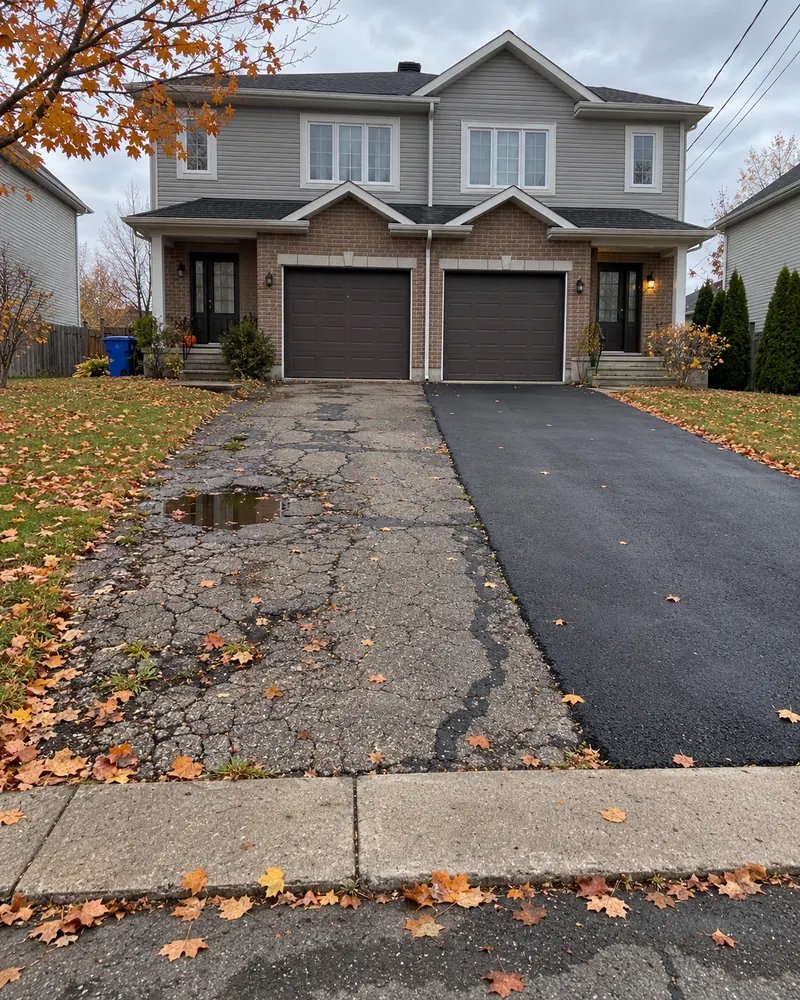
How Long Does an Asphalt Driveway Last in Quebec (and How to Extend Its Life)
Foundation, thickness, drainage, sealer: what determines the lifespan of an asphalt driveway in Quebec, the end-of-life signs, the mistakes to avoid.
Read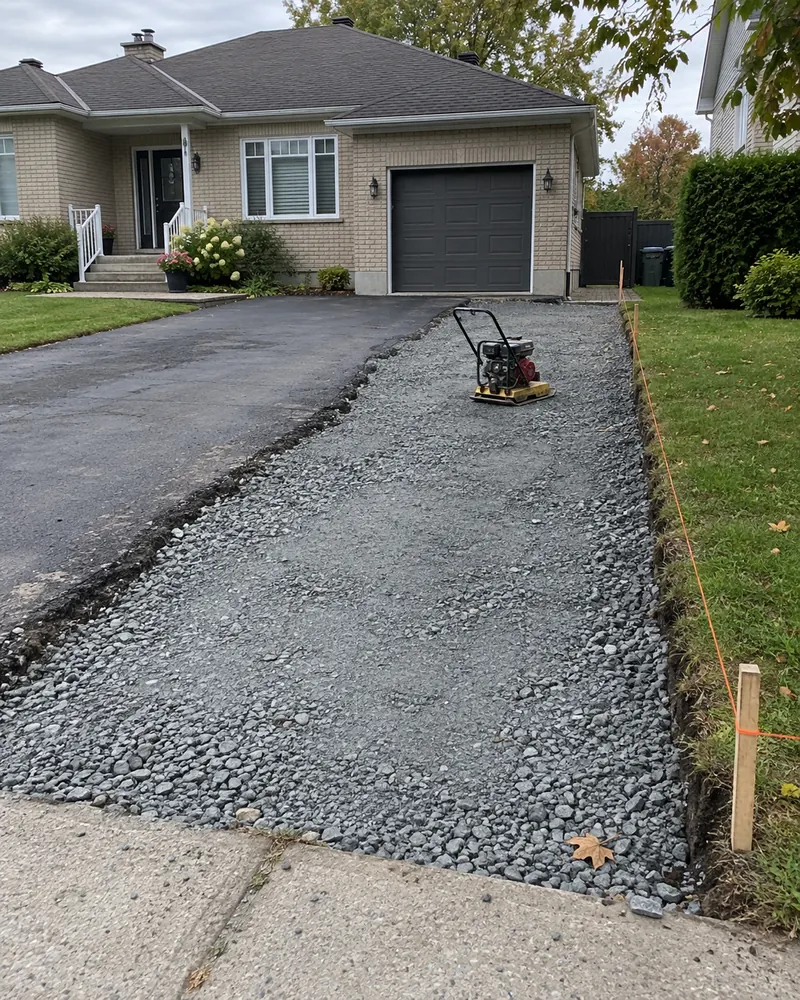
Driveway permits: what 16 cities require (rules checked in 2026)
Repaving as is, gravel to asphalt, widening: what Laval, Terrebonne, Longueuil, Brossard and 12 other cities require. Widths, curb cuts, fees and deadlines.
ReadBefore the freeze, not next spring.
Two minutes of questions, or a photo by text. We call you back quickly, come take a look and you get your price, free.